 Add to Chrome
 Add to Firefox
 Add to Edge
Forest-Guided Semantic Transport for Label-Supervised Manifold Alignment
Feb 01, 2026
Label-supervised manifold alignment bridges the gap between unsupervised and correspondence-based paradigms by leveraging shared label information to align multimodal datasets. Still, most existing methods rely on Euclidean geometry to model intra-domain relationships. This approach can fail when features are only weakly related to the task of interest, leading to noisy, semantically misleading structure and degraded alignment quality. To address this limitation, we introduce FoSTA (Forest-guided Semantic Transport Alignment), a scalable alignment framework that leverages forest-induced geometry to denoise intra-domain structure and recover task-relevant manifolds prior to alignment. FoSTA builds semantic representations directly from label-informed forest affinities and aligns them via fast, hierarchical semantic transport, capturing meaningful cross-domain relationships. Extensive comparisons with established baselines demonstrate that FoSTA improves correspondence recovery and label transfer on synthetic benchmarks and delivers strong performance in practical single-cell applications, including batch correction and biological conservation.

GraIP: A Benchmarking Framework For Neural Graph Inverse Problems
Jan 26, 2026A wide range of graph learning tasks, such as structure discovery, temporal graph analysis, and combinatorial optimization, focus on inferring graph structures from data, rather than making predictions on given graphs. However, the respective methods to solve such problems are often developed in an isolated, task-specific manner and thus lack a unifying theoretical foundation. Here, we provide a stepping stone towards the formation of such a foundation and further development by introducing the Neural Graph Inverse Problem (GraIP) conceptual framework, which formalizes and reframes a broad class of graph learning tasks as inverse problems. Unlike discriminative approaches that directly predict target variables from given graph inputs, the GraIP paradigm addresses inverse problems, i.e., it relies on observational data and aims to recover the underlying graph structure by reversing the forward process, such as message passing or network dynamics, that produced the observed outputs. We demonstrate the versatility of GraIP across various graph learning tasks, including rewiring, causal discovery, and neural relational inference. We also propose benchmark datasets and metrics for each GraIP domain considered, and characterize and empirically evaluate existing baseline methods used to solve them. Overall, our unifying perspective bridges seemingly disparate applications and provides a principled approach to structural learning in constrained and combinatorial settings while encouraging cross-pollination of existing methods across graph inverse problems.
Scalable Tree Ensemble Proximities in Python
Jan 06, 2026Tree ensemble methods such as Random Forests naturally induce supervised similarity measures through their decision tree structure, but existing implementations of proximities derived from tree ensembles typically suffer from quadratic time or memory complexity, limiting their scalability. In this work, we introduce a general framework for efficient proximity computation by defining a family of Separable Weighted Leaf-Collision Proximities. We show that any proximity measure in this family admits an exact sparse matrix factorization, restricting computation to leaf-level collisions and avoiding explicit pairwise comparisons. This formulation enables low-memory, scalable proximity computation using sparse linear algebra in Python. Empirical benchmarks demonstrate substantial runtime and memory improvements over traditional approaches, allowing tree ensemble proximities to scale efficiently to datasets with hundreds of thousands of samples on standard CPU hardware.
Leveraging Parameter Space Symmetries for Reasoning Skill Transfer in LLMs
Nov 13, 2025Task arithmetic is a powerful technique for transferring skills between Large Language Models (LLMs), but it often suffers from negative interference when models have diverged during training. We address this limitation by first aligning the models' parameter spaces, leveraging the inherent permutation, rotation, and scaling symmetries of Transformer architectures. We adapt parameter space alignment for modern Grouped-Query Attention (GQA) and SwiGLU layers, exploring both weight-based and activation-based approaches. Using this alignment-first strategy, we successfully transfer advanced reasoning skills to a non-reasoning model. Experiments on challenging reasoning benchmarks show that our method consistently outperforms standard task arithmetic. This work provides an effective approach for merging and transferring specialized skills across evolving LLM families, reducing redundant fine-tuning and enhancing model adaptability.
Less is More: Undertraining Experts Improves Model Upcycling
Jun 17, 2025Modern deep learning is increasingly characterized by the use of open-weight foundation models that can be fine-tuned on specialized datasets. This has led to a proliferation of expert models and adapters, often shared via platforms like HuggingFace and AdapterHub. To leverage these resources, numerous model upcycling methods have emerged, enabling the reuse of fine-tuned models in multi-task systems. A natural pipeline has thus formed to harness the benefits of transfer learning and amortize sunk training costs: models are pre-trained on general data, fine-tuned on specific tasks, and then upcycled into more general-purpose systems. A prevailing assumption is that improvements at one stage of this pipeline propagate downstream, leading to gains at subsequent steps. In this work, we challenge that assumption by examining how expert fine-tuning affects model upcycling. We show that long fine-tuning of experts that optimizes for their individual performance leads to degraded merging performance, both for fully fine-tuned and LoRA-adapted models, and to worse downstream results when LoRA adapters are upcycled into MoE layers. We trace this degradation to the memorization of a small set of difficult examples that dominate late fine-tuning steps and are subsequently forgotten during merging. Finally, we demonstrate that a task-dependent aggressive early stopping strategy can significantly improve upcycling performance.
Geometry-Aware Edge Pooling for Graph Neural Networks
Jun 13, 2025Graph Neural Networks (GNNs) have shown significant success for graph-based tasks. Motivated by the prevalence of large datasets in real-world applications, pooling layers are crucial components of GNNs. By reducing the size of input graphs, pooling enables faster training and potentially better generalisation. However, existing pooling operations often optimise for the learning task at the expense of fundamental graph structures and interpretability. This leads to unreliable performance across varying dataset types, downstream tasks and pooling ratios. Addressing these concerns, we propose novel graph pooling layers for structure aware pooling via edge collapses. Our methods leverage diffusion geometry and iteratively reduce a graph's size while preserving both its metric structure and structural diversity. We guide pooling using magnitude, an isometry-invariant diversity measure, which permits us to control the fidelity of the pooling process. Further, we use the spread of a metric space as a faster and more stable alternative ensuring computational efficiency. Empirical results demonstrate that our methods (i) achieve superior performance compared to alternative pooling layers across a range of diverse graph classification tasks, (ii) preserve key spectral properties of the input graphs, and (iii) retain high accuracy across varying pooling ratios.
RETRO SYNFLOW: Discrete Flow Matching for Accurate and Diverse Single-Step Retrosynthesis
Jun 04, 2025A fundamental problem in organic chemistry is identifying and predicting the series of reactions that synthesize a desired target product molecule. Due to the combinatorial nature of the chemical search space, single-step reactant prediction -- i.e. single-step retrosynthesis -- remains challenging even for existing state-of-the-art template-free generative approaches to produce an accurate yet diverse set of feasible reactions. In this paper, we model single-step retrosynthesis planning and introduce RETRO SYNFLOW (RSF) a discrete flow-matching framework that builds a Markov bridge between the prescribed target product molecule and the reactant molecule. In contrast to past approaches, RSF employs a reaction center identification step to produce intermediate structures known as synthons as a more informative source distribution for the discrete flow. To further enhance diversity and feasibility of generated samples, we employ Feynman-Kac steering with Sequential Monte Carlo based resampling to steer promising generations at inference using a new reward oracle that relies on a forward-synthesis model. Empirically, we demonstrate \nameshort achieves $60.0 \%$ top-1 accuracy, which outperforms the previous SOTA by $20 \%$. We also substantiate the benefits of steering at inference and demonstrate that FK-steering improves top-$5$ round-trip accuracy by $19 \%$ over prior template-free SOTA methods, all while preserving competitive top-$k$ accuracy results.
Random Forest Autoencoders for Guided Representation Learning
Feb 18, 2025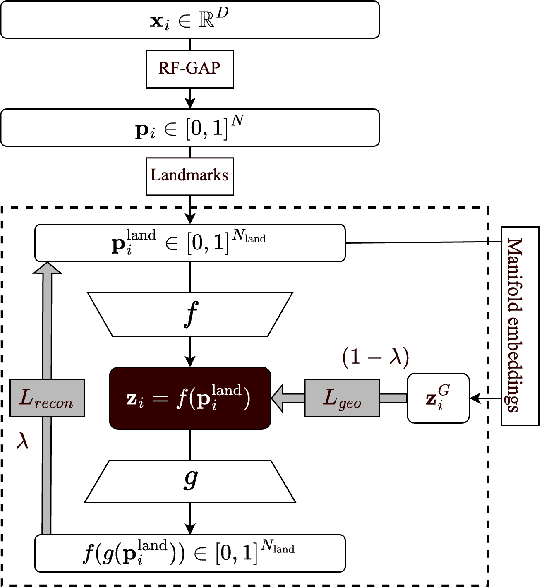
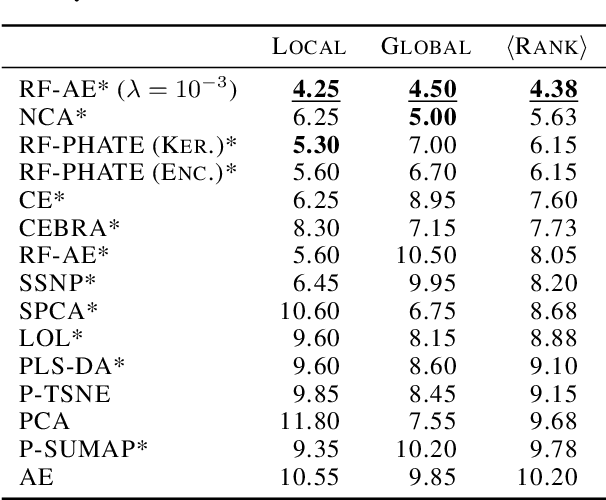
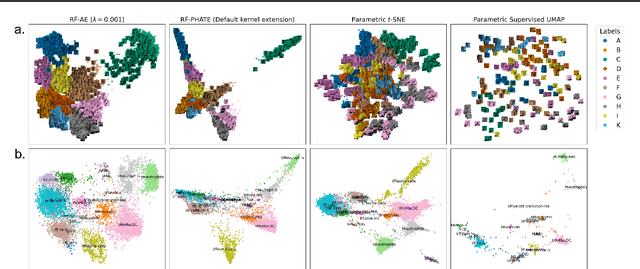
Decades of research have produced robust methods for unsupervised data visualization, yet supervised visualization$\unicode{x2013}$where expert labels guide representations$\unicode{x2013}$remains underexplored, as most supervised approaches prioritize classification over visualization. Recently, RF-PHATE, a diffusion-based manifold learning method leveraging random forests and information geometry, marked significant progress in supervised visualization. However, its lack of an explicit mapping function limits scalability and prevents application to unseen data, posing challenges for large datasets and label-scarce scenarios. To overcome these limitations, we introduce Random Forest Autoencoders (RF-AE), a neural network-based framework for out-of-sample kernel extension that combines the flexibility of autoencoders with the supervised learning strengths of random forests and the geometry captured by RF-PHATE. RF-AE enables efficient out-of-sample supervised visualization and outperforms existing methods, including RF-PHATE's standard kernel extension, in both accuracy and interpretability. Additionally, RF-AE is robust to the choice of hyper-parameters and generalizes to any kernel-based dimensionality reduction method.
Principal Curvatures Estimation with Applications to Single Cell Data
Feb 06, 2025
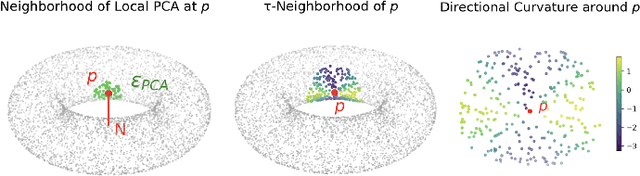
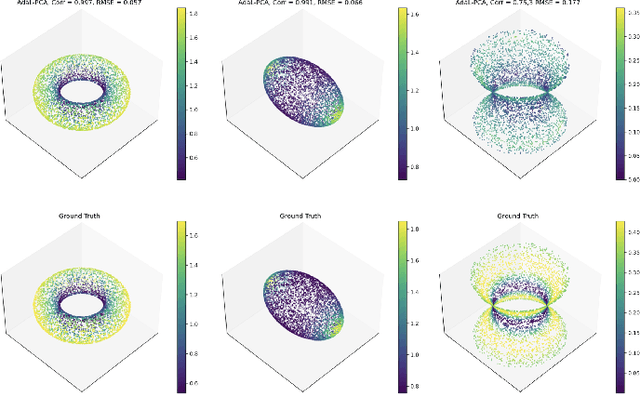
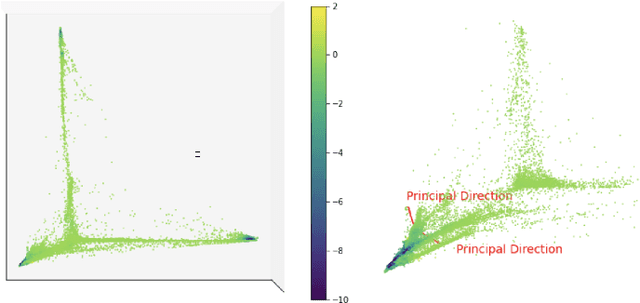
The rapidly growing field of single-cell transcriptomic sequencing (scRNAseq) presents challenges for data analysis due to its massive datasets. A common method in manifold learning consists in hypothesizing that datasets lie on a lower dimensional manifold. This allows to study the geometry of point clouds by extracting meaningful descriptors like curvature. In this work, we will present Adaptive Local PCA (AdaL-PCA), a data-driven method for accurately estimating various notions of intrinsic curvature on data manifolds, in particular principal curvatures for surfaces. The model relies on local PCA to estimate the tangent spaces. The evaluation of AdaL-PCA on sampled surfaces shows state-of-the-art results. Combined with a PHATE embedding, the model applied to single-cell RNA sequencing data allows us to identify key variations in the cellular differentiation.
Non-Uniform Parameter-Wise Model Merging
Dec 20, 2024Combining multiple machine learning models has long been a technique for enhancing performance, particularly in distributed settings. Traditional approaches, such as model ensembles, work well, but are expensive in terms of memory and compute. Recently, methods based on averaging model parameters have achieved good results in some settings and have gained popularity. However, merging models initialized differently that do not share a part of their training trajectories can yield worse results than simply using the base models, even after aligning their neurons. In this paper, we introduce a novel approach, Non-uniform Parameter-wise Model Merging, or NP Merge, which merges models by learning the contribution of each parameter to the final model using gradient-based optimization. We empirically demonstrate the effectiveness of our method for merging models of various architectures in multiple settings, outperforming past methods. We also extend NP Merge to handle the merging of multiple models, showcasing its scalability and robustness.